Three different questions people call "backup"
People go looking for a Time Machine alternative for one of three reasons, and they need different software each time.
"My Mac died." You need a second copy of everything, somewhere the first copy's failure cannot reach. Ideally two: one in the building for speed, one out of it for fire and theft.
"I broke this an hour ago." Nothing is lost, nothing failed. One folder is in the wrong state because a find-and-replace went too far, a sync half-finished or a script renamed everything. What you want is the folder as it was at 14:20, not a restore of the disk.
"I need the version from last month." A specific file, a specific earlier state, and no idea exactly which day.
Time Machine answers the first well, the third adequately and the second badly. That is not a flaw in it - it was built for the first - but it is why the honest answer to "what should replace Time Machine" is usually "nothing, add a layer next to it".
What Time Machine is actually good at
It is free, it is already on your Mac, and it does the hard part: a complete, bootable-adjacent copy of the whole disk with an interface non-technical people can use under stress. Nothing on this page replaces that.
Two details are worth knowing because they explain most of the complaints. With
Back Up Automatically on and the disk formatted APFS, macOS takes a local
snapshot of the startup disk roughly every hour and keeps it for 24 hours,
plus one snapshot of the last successful backup. That is why Time Machine can
often go back an hour with the backup drive unplugged - and why it usually
cannot go back a week. You can see them with tmutil listlocalsnapshots /.
Those snapshots are also most of what System Settings reports as purgeable space. macOS counts it as available and releases it when something needs the room, which is correct behavior presented confusingly, and it is why no third-party app can "free" it for you.
The limits, then: hourly granularity, whole-disk scope, and a restore experience aimed at the disk rather than at one folder.
Where the real alternatives win
Backblaze is the offsite answer: unlimited continuous backup of one Mac for about $99 a year, restores by download or by a posted drive. It wins on the scenario Time Machine cannot cover at all, which is the drive and the backup drive being in the same room during the same flood.
Arq is the same idea with your own storage behind it - S3, Backblaze B2, Wasabi, a NAS - and end-to-end encryption you hold the keys for. Arq Premium is $59.99 a year with 1 TB included and covers five machines; Arq 7 is $49.99 once if you bring your own bucket. Both rise on 1 September 2026, to $69.99 and $59.99. It wins on control.
Carbon Copy Cloner and SuperDuper are not incremental backup at all. They make a full, mountable copy of a volume, which is the fastest way back from "this Mac is dead and I have a deadline". CCC is about $50, one-time, and its snapshot navigator makes it a competent Time Machine substitute too.
ChronoSync is the one to reach for when the job is really scheduled one-directional sync between machines and volumes rather than backup.
None of the five is a version history. They all answer "my Mac died", at different distances and different prices.
Sync is not history
Dropbox, Google Drive and iCloud Drive get counted as backup because they usually do get your file back, and they are worth checking first for anything inside them. But the shape is wrong in three ways.
They cover one folder. Everything outside the synced tree - which for most people is most of their work - is not in scope.
Deletion propagates. Delete on the Mac, it is gone on the server; the recovery window is a rubbish bin with a deadline, not a copy. Dropbox holds versions 30 days on Basic and Plus, 180 on Professional. Google Drive keeps a version 30 days or until 100 newer ones exist, unless you clicked Keep forever. iCloud Drive does not offer general version history at all: its 30-day Recently Deleted recovers files you deleted, not the file you saved over.
And restoring is per file. Dropbox Rewind can roll a folder back, on paid plans, which is the exception that proves the point: everybody else makes you repair a broken folder one file at a time.
The layer none of them covers
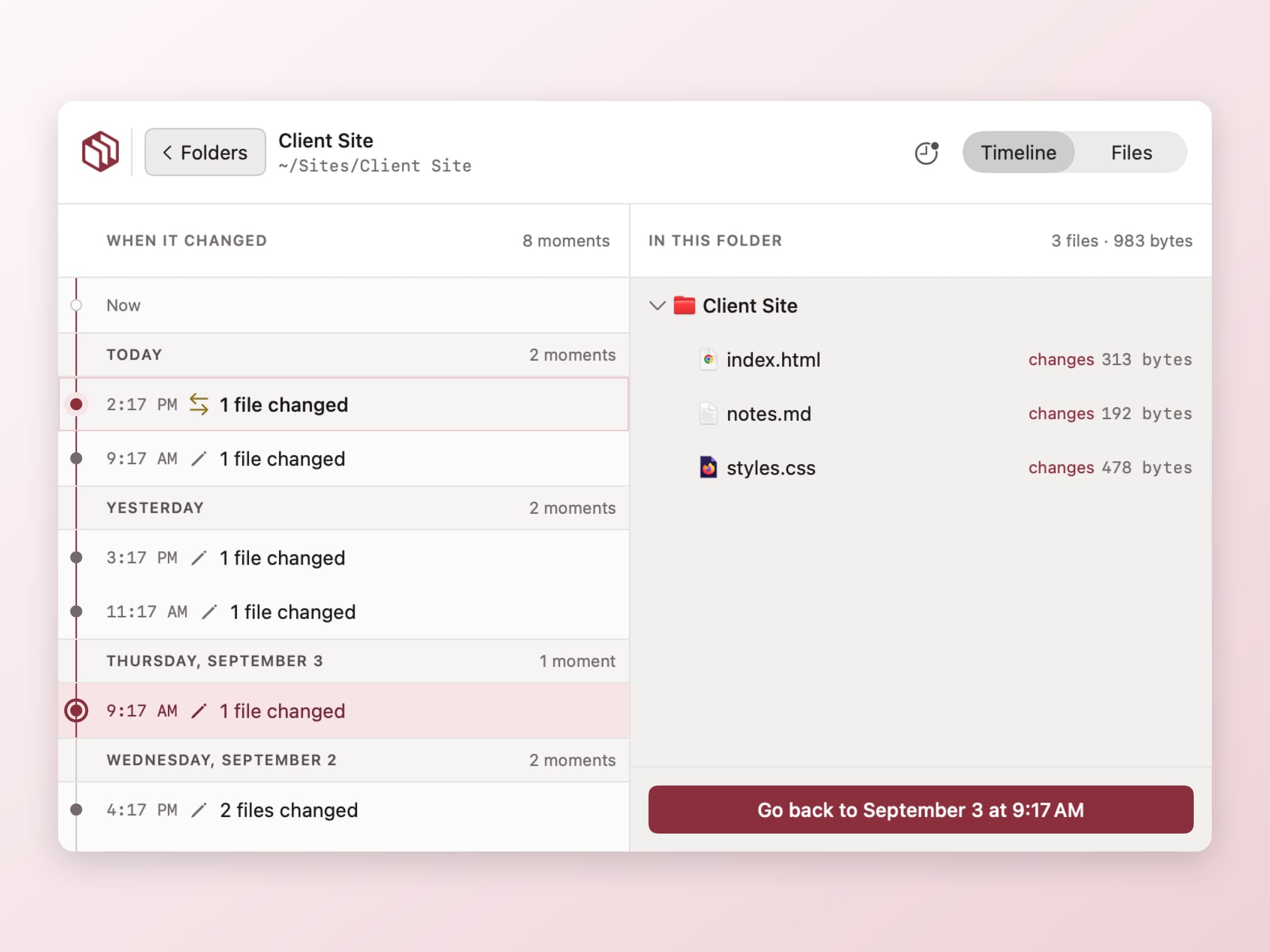
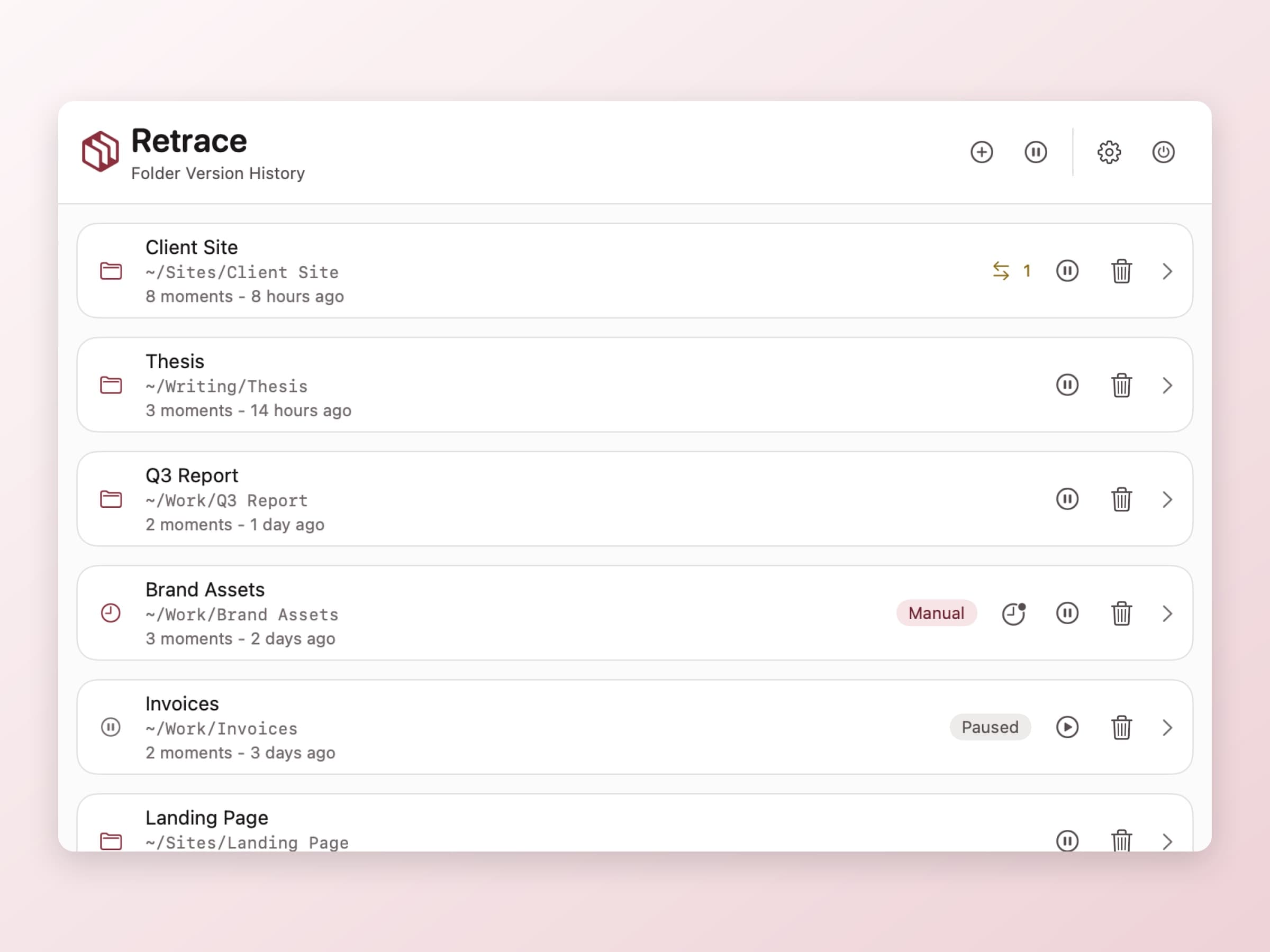
That leaves the second question - "I broke this an hour ago" - with no good answer, which is what Retrace is for. You right-click a folder in Finder and switch history on. A few seconds after you stop editing a file it saves a copy, and because those copies are APFS clones sharing their data with the original, taking one costs effectively nothing.
The unit of restore is the folder at a moment, not one file, and the rewind captures the folder's current state before it changes anything, so undoing the rewind is just rewinding back. Everything stays on the same disk and on the same Mac: no account, no upload, and it works with the network off.
Which is also the honest limit. Same disk means a dead drive takes the history with it, so Retrace is a layer over a backup and never a substitute for one. It is covered feature by feature in how to recover an overwritten file on a Mac.
Side by side
| Tool | Answers | Copy lives | Granularity | Cost |
|---|---|---|---|---|
| Time Machine | My Mac died | External disk, plus 24h of local snapshots | Hourly | Free |
| Backblaze | Fire, theft, flood | Their cloud | Continuous | ~$99/year |
| Arq | Fire, theft, flood | Your bucket or NAS | Scheduled | $59.99/year, or $49.99 once |
| Carbon Copy Cloner | Back to work today | A mountable clone volume | Scheduled | ~$50 once |
| Dropbox, Drive, iCloud | The synced folder | Their server | Per save, per file | Storage plan |
| Retrace | I broke this an hour ago | Same disk, same Mac | Per save, per folder | $8.99 once |
Most people should end up with two rows, not one: something that answers the first column's first line, and something that answers its last. The two failures have nothing in common except the word backup.
One thing every row shares is that it needs free disk space, and a Mac with a full disk quietly stops backing up. If that is the actual problem, Sweep files and cleans the folders you point it at, and there is a survey in free up disk space on a Mac.
Prices and features checked on 27 August 2026.

