What Hazel is actually good at
Hazel watches folders and acts on what lands in them. You build a rule out of conditions - name, kind, date added, the site a file came from, tags - and give it actions: move, rename, sort into subfolders, tag, archive, upload, throw away. Then it runs quietly, whether or not you are looking.
Two things have kept it at the top of this category for fifteen years. The first is reach: a rule can end in AppleScript, JavaScript or a shell script, so anything you can express in code is one condition away from being automatic. The second is the matching engine, which handles dates, custom text patterns and nested conditions properly rather than approximately. It also carries App Sweep, which offers to clear out an application's leftover support files when you drag it to the Trash.
Hazel is $42 for one Mac, $65 for a family pack covering five, and $20 to upgrade from an older version. There is a free trial before you decide.
If that description is what you want, buy Hazel. Nothing further down this page beats it on capability, and this is not a post arguing otherwise.
Why people go looking anyway
Three reasons come up, and only one of them is the price.
The rule you wrote in March. Capability arrives as a growing pile of conditions. A rule that sorts invoices ends up matching a date pattern, a partial filename and a tag, with an exception for one client, and six months later you have to reconstruct your own thinking before you dare change it. People do not leave because they need less power. They leave because they want a rule they can still read.
It runs before you have agreed to anything. A rule fires when the file lands. If the conditions were slightly wrong, the first sign is a file that is not where you left it, and finding out where it went is a trip through the log.
The job was smaller than the tool. A very common brief is: put downloads into folders by type, and stop the folder from becoming a landfill. That does not need a scripting engine.
What macOS already does for free
Try these first. They cost nothing and they are already installed.
Folder Actions attach an AppleScript to a folder and run it when something arrives. Right-click a folder, Services, Folder Actions Setup. The scripts Apple ships will sort images or open new items; anything else is yours to write.
Automator and Shortcuts both build the same kind of thing with a visual editor, and Shortcuts can be triggered from the menu bar, a keyboard shortcut or another app. For "rename these 200 files and file them by year", a Shortcut you run by hand once a month is a perfectly good answer.
Smart Folders in Finder do not move anything, and that is sometimes the point: a saved search for "PDFs added in the last week" gives you the view without touching the files.
Where all three stop is the same place. They have no preview, no history and no undo, so the way you learn a rule was wrong is by finding the damage. Writing one is a project rather than a setting, and a script that silently stops running after a macOS update gives you no notification at all.
The simpler paid route
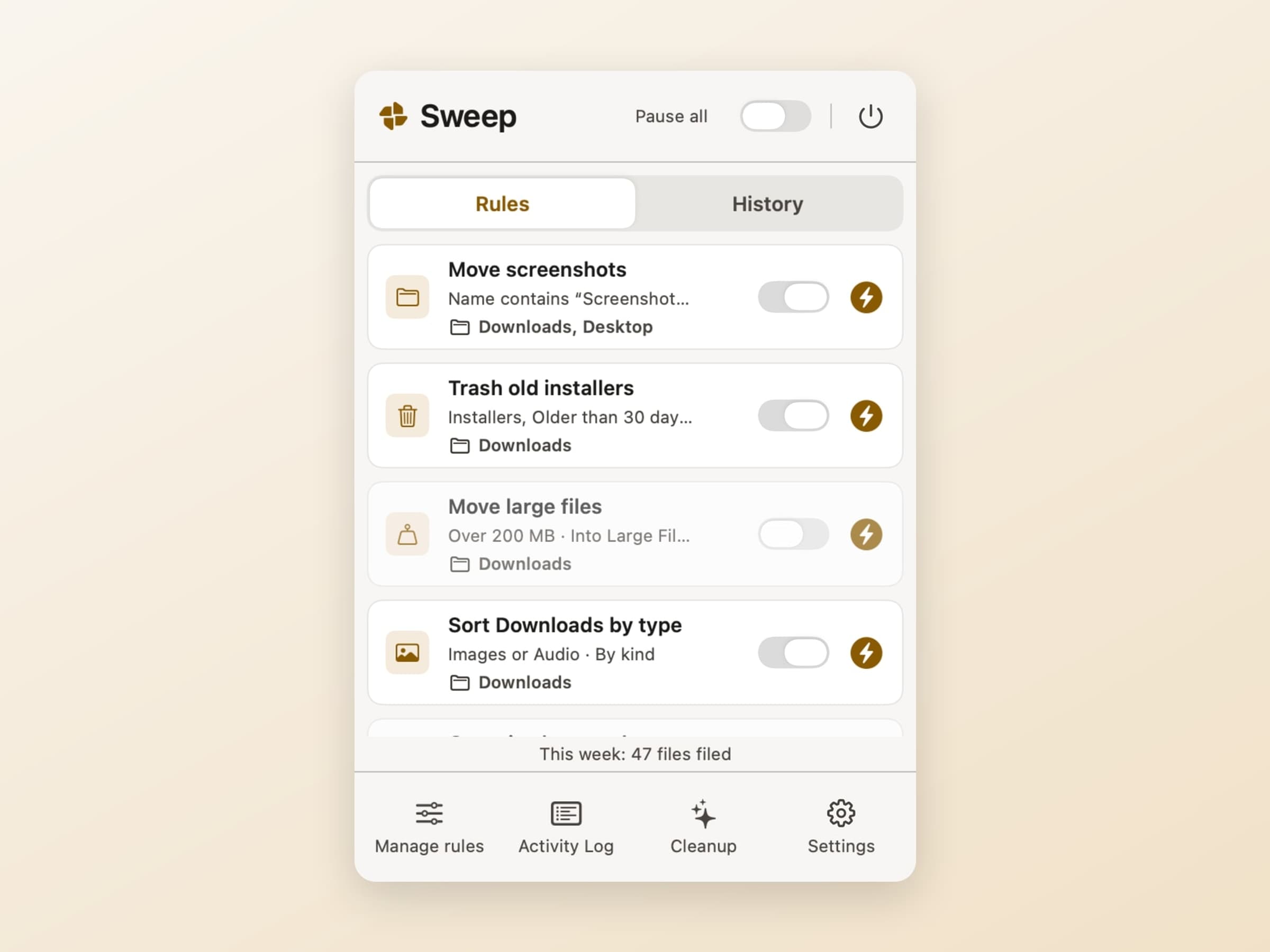
Sweep takes the opposite bet from Hazel: fewer concepts, no rule language, and nothing that happens without a preview first. A rule is built from plain conditions - kind, name contains, size, age - and there is no regular expression syntax to learn anywhere in the app. It watches the folders you name and files what arrives the moment it lands.
The part that matters more than the matching is what happens next.
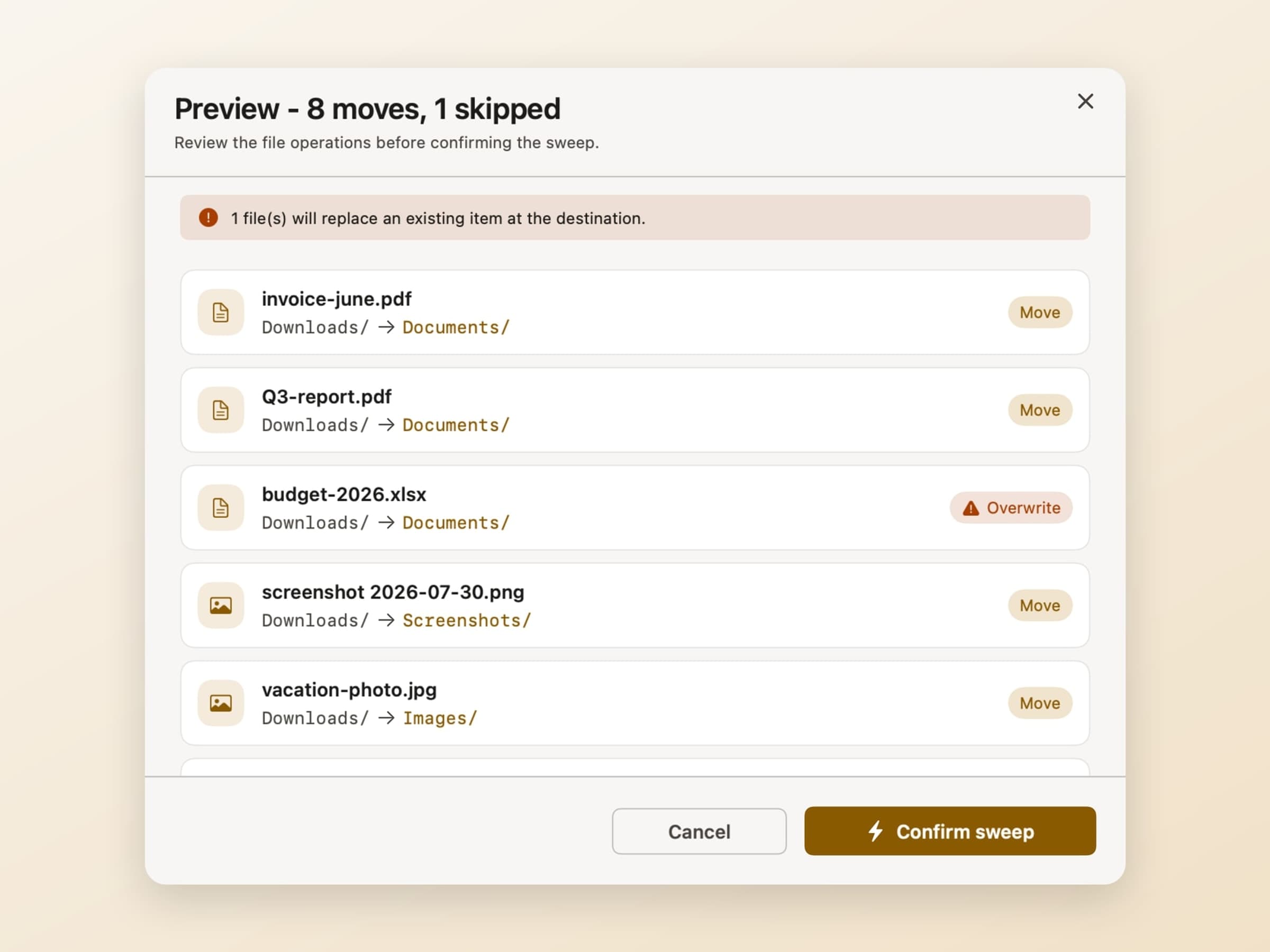
Every rule can be run as a dry run: the full list of moves, the files it skipped and why, and a warning on any row that would overwrite something. Once a batch has run, one click puts it back, and the activity log survives a relaunch, so "where did that file go" is a question the app answers rather than one you investigate. Nothing is ever deleted - removals go to the Trash.
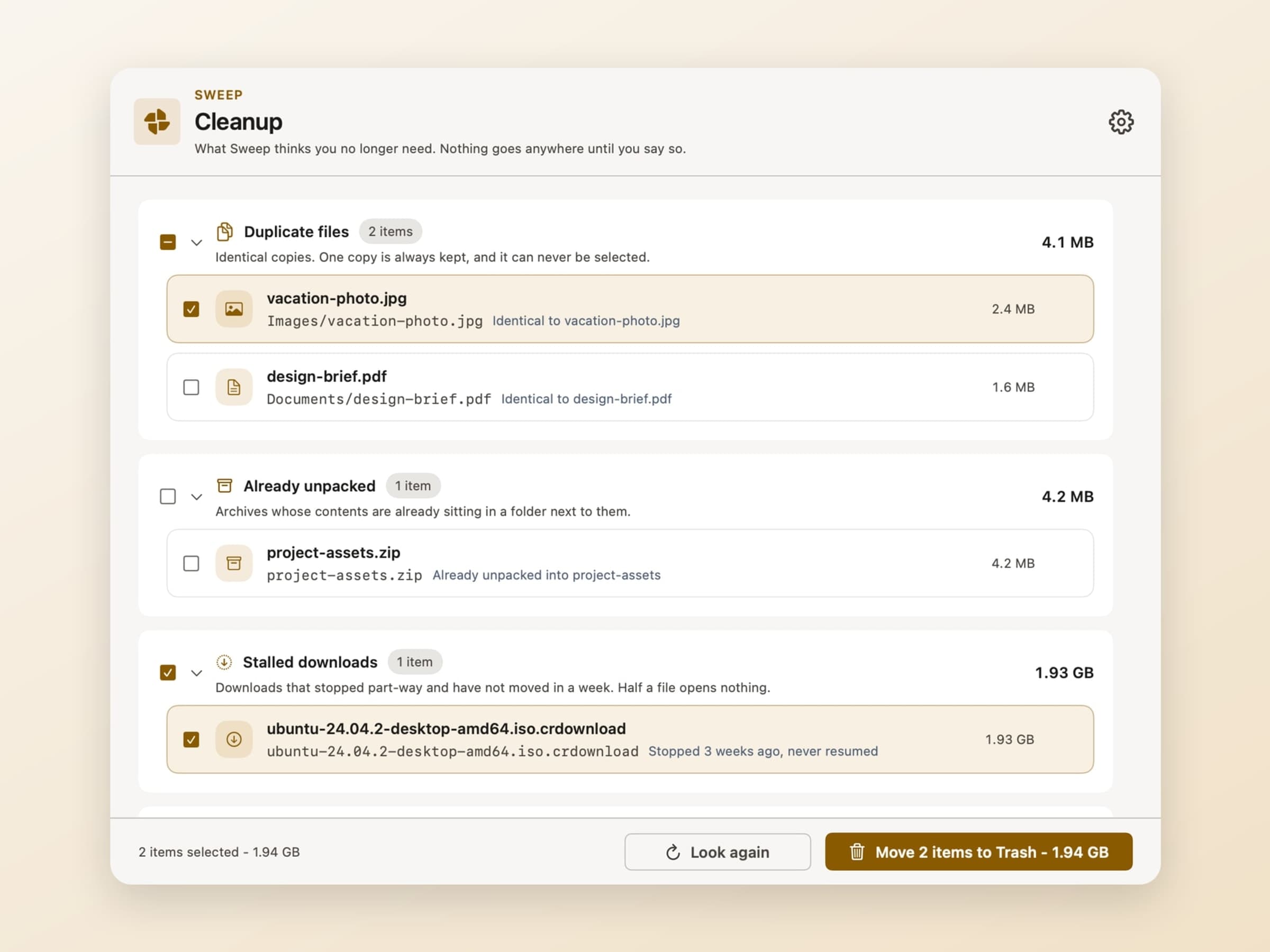
A separate Cleanup pass looks at what has accumulated rather than what just arrived: byte-identical duplicates, archives already unpacked into a folder beside them, installers nobody has touched in months.
Two limits worth knowing before you download it. Sweep matches on filesystem metadata and never reads file contents, which is why a rule runs instantly on a 4 GB video and also why it cannot file something by what is written inside it. And it has no scheduler: rules fire when a file arrives or when you press Run. It is $9.99 once, with a 30-day trial that needs no card and no email, and the mechanism is covered feature by feature in sorting files automatically on a Mac.
Where the alternatives win
Hazel wins on everything that ends in a script. Renaming from the contents of a PDF, uploading to a server, sorting by a pattern you invented, chaining a rule into a shell command: all of that is Hazel and none of it is Sweep. It also matches on tags and on the source URL of a download, and App Sweep is a genuinely useful thing to have running for free alongside its main job.
Keyboard Maestro, around $36, is a general macro engine that happens to support folder triggers. If you already own it for text expansion and window management, adding a file rule costs nothing extra, and it can drive other applications in ways no file organizer will.
Folder Actions and Shortcuts win on price and on the fact that they cannot be uninstalled by accident. For a single job you do rarely, a Shortcut is the right size of solution.
DropZone solves an adjacent problem well: a grid you drag files onto to send them somewhere. It is manual by design, which some people want after being surprised by an automatic rule once.
Side by side
| Tool | How a rule is written | Preview before it runs | Undo | Cost |
|---|---|---|---|---|
| Hazel | Conditions, patterns, optional script | No | Per action, from the log | $42 once |
| Keyboard Maestro | Macro actions | No | Depends on the action | ~$36 once |
| Folder Actions | AppleScript | No | No | Free |
| Shortcuts | Visual actions, run by hand | No | No | Free |
| Sweep | Plain conditions, no syntax | Yes, every rule | One click per batch | $9.99 once |
The right question is not which app is more powerful. It is whether the rule you are about to write is one you will still understand in six months, and whether the app will show you what it is about to do. If the answer to both is yes, the cheaper tool is the better tool.
If the folder you are automating is one where mistakes actually hurt, keep a history under it as well: Retrace records a folder's earlier states so a bad rule is an undo rather than an afternoon, and Time Machine alternatives for Mac covers where that fits next to a real backup. For leftovers of apps you removed long ago, Unroot does the job App Sweep does, after the fact.
Prices and features checked on 27 August 2026.


