What a menu bar task timer is
A menu bar task timer is a small macOS app that keeps two things permanently visible next to the clock: the name of the task you are working on, and how much of its estimated time is left. Nothing else.
That is a narrower job than a to-do app and a wider one than a stopwatch. A to-do app is optimised for capture and storage, which is why opening one at three in the afternoon means re-reading fourteen items and re-deciding what matters. A stopwatch counts minutes but has no idea what they are for. A task timer answers one question, continuously: what am I supposed to be doing, and for how much longer.
Anchored is the one this article walks through. Everything below is in the shipping version, and the screenshots are of the real app rather than mockups.
The label in the menu bar
The whole design rests on the label. Anchored puts the task title and the remaining time in the menu bar as one string:
Write PRD · 32m
Time is formatted as minutes below an hour, then as 1h or 1h 25m. When the
estimate runs out the label does not disappear or start beeping - it turns a
muted coral, so overrun is legible at a glance without being an alarm. With an
empty queue it reads What's next?, which is a prompt rather than a blank.
Long titles are the obvious risk with an approach like this, so the truncation point is yours: a slider in Settings sets the maximum label length anywhere from 20 to 60 characters, and Minimal idle reduces the empty state to the anchor glyph alone.
The popover: one anchor, a queue, a day
Clicking the label - or pressing the global shortcut - opens a 360 by 560 point popover with three bands.
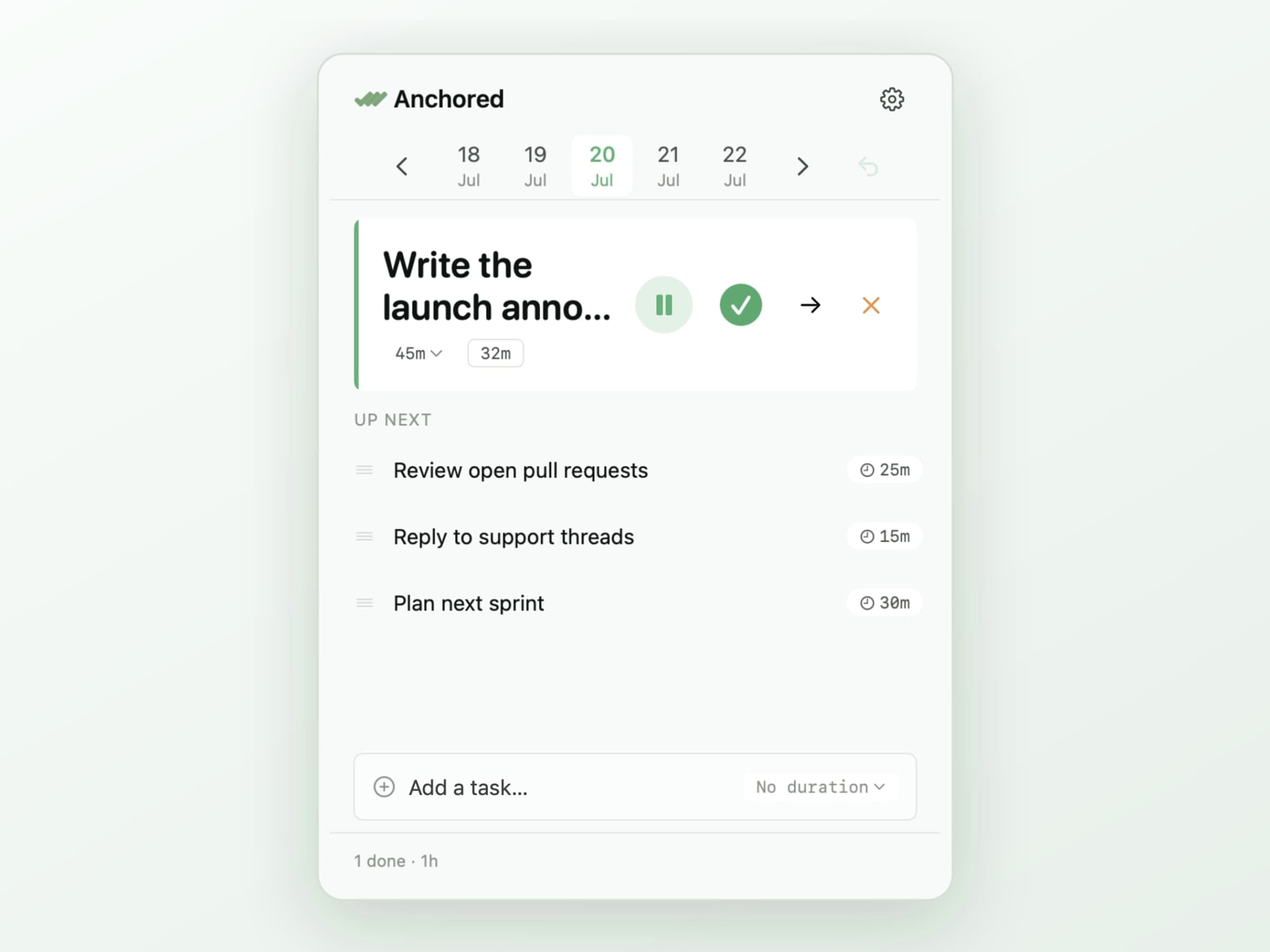
At the top is a day strip: five days at a time, arrows to shift by one, and a Today button. It moves forwards as well as back, so the queue doubles as a lightweight planner - and past days are read-only, showing what actually happened rather than offering to let you rewrite it.
Below that is the anchor task, the one the menu bar is showing. The card carries a live countdown ring, a play and pause button, and a duration dropdown that retimes a session already in progress. Pausing is lossless: elapsed time is folded into the task's total the moment you pause, so a stop for coffee does not corrupt the number. Hovering reveals three actions - complete it, move it to the next day, or delete it.
Under the anchor is Up next, the short queue of what follows. Rows drag to reorder, the last row is an inline add field with a duration pill beside it, and tapping any row expands an editor in place for the title, the duration and a note. The bottom band is a one-line daily summary: 6 done · 3h 12m focused.
Quick add, and durations you can type
The queue is only useful if adding to it costs nothing, so Anchored ships a separate quick-add panel on a global shortcut. It is a floating, non-activating window: it appears over whatever you were doing, takes your typing, and hands focus straight back.
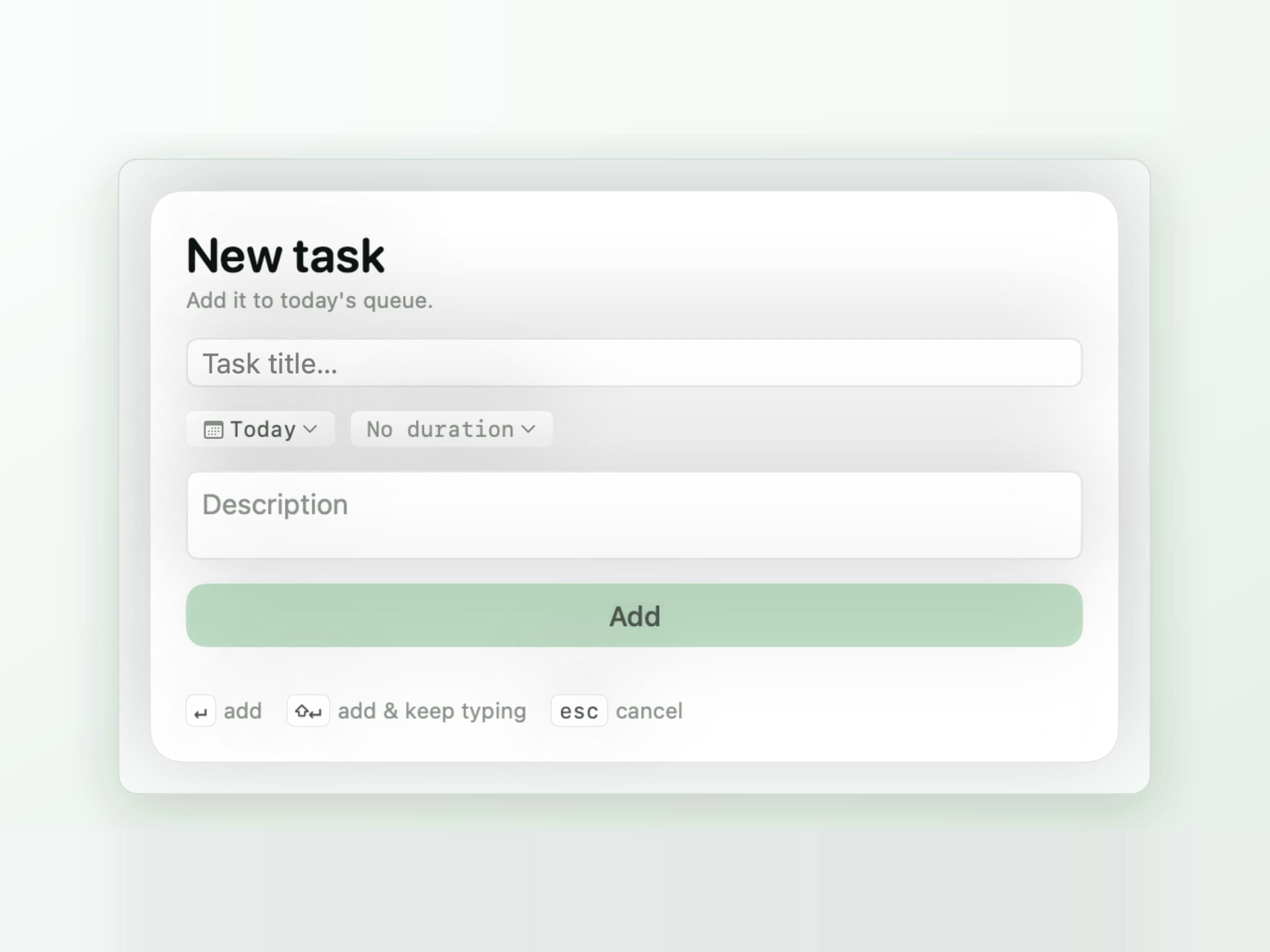
Enter adds the task and closes. Shift Enter adds it and keeps the field open, which is how you empty your head of five things in about fifteen seconds. Escape cancels.
Estimates are only worth writing down if writing them down is fast, so the parser
accepts the shapes people actually type: 25m, 1h, 1h30m, 1.5h, and ~25m
for "roughly". Case and spacing do not matter, and there are presets at 15, 25,
45, 60 and 90 minutes. You can skip the duration entirely - a task without one is
a perfectly valid queue entry that simply shows its title with no countdown
beside it. The countdown starts when the task becomes the anchor, not when you
wrote it down.
When the timer runs out
The end of an estimate is where most timers get annoying, so this is the part worth reading closely.
A notification fires with a body that just states the fact - "45 minutes done." - and carries two actions. Done completes the task and opens the popover on the next one. The second is an extension whose size you set yourself: +5, +10, +15 or +30 minutes, applied silently, with no window and no further interruption. Running over an estimate is normal, and the app treats it that way.
Choosing Done opens a full-takeover panel inside the popover: a checkmark, a recap of how long the task actually took, then the next task with Start and Skip buttons. It advances on its own after a beat and a half unless you hover, so the common case needs no clicks at all.
Built for the keyboard
Anchored is usable entirely from the keyboard, and the shortcut surface is small enough to memorise in a day.
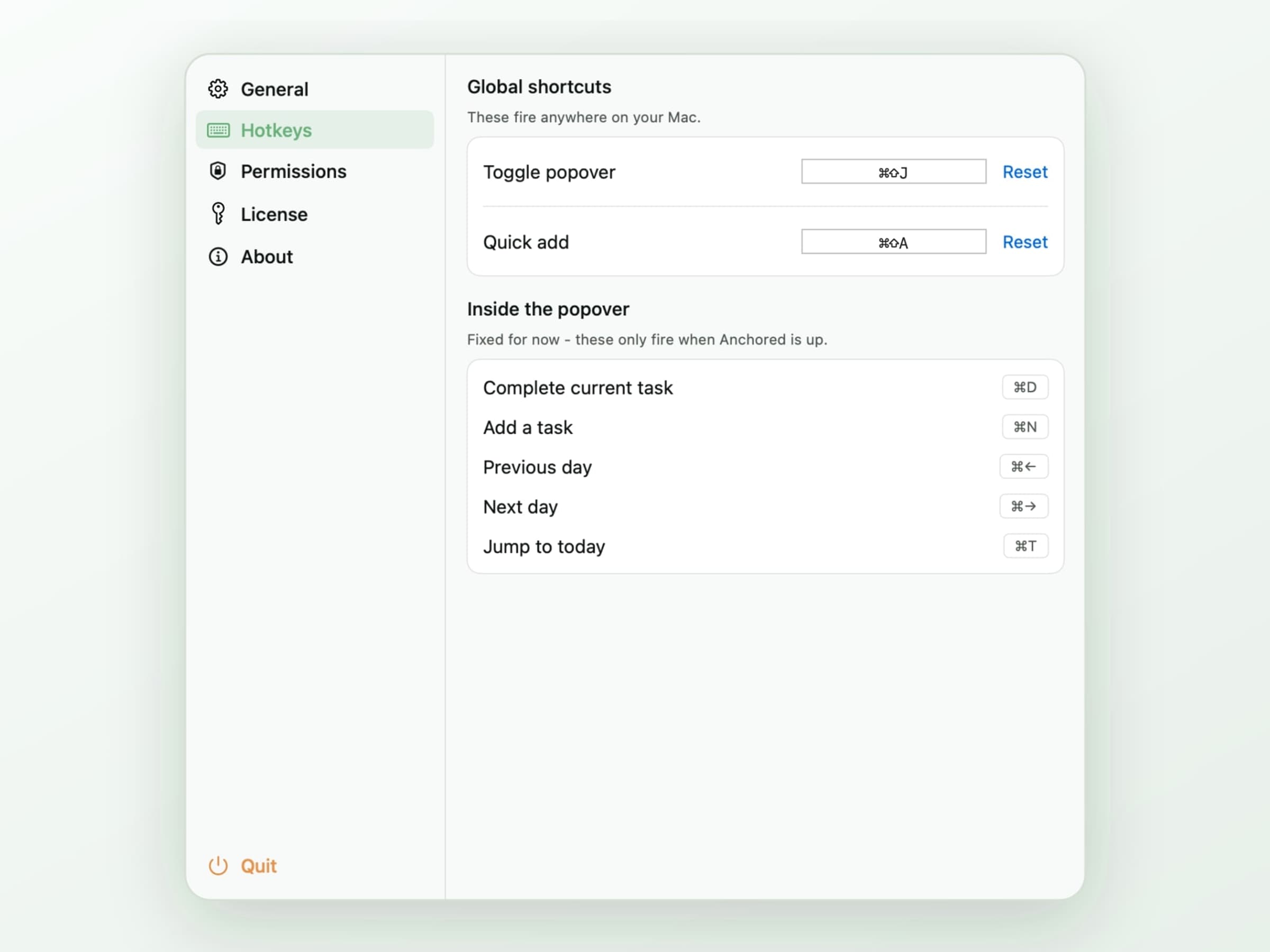
Two shortcuts are global: Command Shift J toggles the popover and Command Shift A opens quick add. Both are rebindable, each has a Reset link, and the recorder checks for conflicts as you type - if you map two actions to the same combination it names both rather than silently letting one win. Five more are fixed and work inside the popover: Command D completes the current task, Command N adds one, Command Left and Command Right move a day, and Command T jumps to today.
Worth knowing for anyone comparing menu bar utilities: the global shortcuts use Carbon hotkey registration, which means Anchored needs no Accessibility permission to make them work.
What it deliberately does not do
The absent features are as much of the design as the present ones.
There is no account and no sync. Nothing is uploaded, and there is no phone app waiting for you to sign up. The trade is real and worth stating plainly: your queue is on one Mac.
There is no backlog management - no projects, tags, filters or recurring-task engine competing with the one you already use. Anchored expects your real list to live wherever it already lives and asks only that you promote one item into it each morning. Unfinished work gets a Move to next day action rather than an automatic rollover, so pushing something forward stays a decision you make.
It asks for exactly one system permission, notifications, and works without that too. No Accessibility, no Screen Recording, no file access. The app is sandboxed, signed and notarised, and the only network traffic is licence checks and update requests. Automation is one App Intent, Add Task to Anchored, which runs from Shortcuts, Spotlight or by voice without launching the app.
What it costs, and what else to look at
Anchored runs on macOS 14 or later, on Apple Silicon and Intel, and takes about 20 MB. It is pay what you want with a suggested price of $3, which includes paying nothing, and it is a one-time purchase rather than a subscription. There is a 14-day trial, and the full specification sits on the Anchored page.
A single-task timer solves exactly one of the several problems people call "I can't focus": choosing. If the problem is starting, a fixed interval is a better lever than an estimate, which is Pawodoro. If it is drifting into other tabs, a blocker like NoMore is the answer. If it is never stopping, Recess interrupts on a schedule that has nothing to do with your work - and there is a longer treatment of that split in the best focus apps for Mac.